 DailyrecordNg …Nigeria's hottest news blog


Related Articles



BY BLAISE UDUNZE
The vision was bold. The expectation was clear. And the promise was powerful. When the Dangote Refinery began operations, it was hailed as Nigeria’s long-awaited escape from decades of energy contradiction, which involves exporting crude oil while importing refined fuel at high costs. It was meant to guarantee supply, stabilize prices, conserve foreign exchange, and most importantly, deliver relief to ordinary Nigerians.
What appears to be a distinct contradiction is that, despite months into its operation, a different reality is emerging, with fuel prices rising sharply. Inflationary pressures are intensifying. This occurrence has forced Nigerians to ask a difficult question once again, one that calls for an urgent answer. Why does a country that produces and refines crude oil still suffer the consequences of global oil shocks?
Looking at the trend, it is clear that the answer lies not just in geopolitics, but in the deeper structure of Nigeria’s oil economy, where global pricing, policy gaps, and now the looming risk of monopoly intersect.
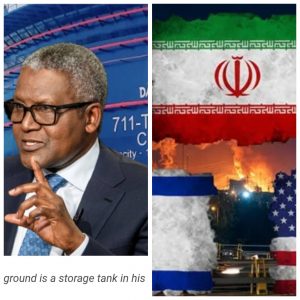
With the recent development, the latest alarming surge in petrol prices has been driven largely by escalating tensions in the Middle East. This is particularly the U.S-Israel strikes on Iran and retaliatory measures from Tehran. A well-known fact is that at the center of the crisis is the Strait of Hormuz, a vital oil transit route through which a significant portion of global supply flows. Any disruption, even a speculative one, triggers immediate spikes in crude prices.
Within a week, oil prices jumped from the mid-$60 range to nearly $120 per barrel. For global markets, this is expected. For Nigeria, it is devastatingly ironic. Because, despite having crude oil in abundance and despite refining it locally, Nigeria remains fully exposed and this has continued to re-echo the same ironic question.
In a rare moment of corporate candor, the refinery’s leadership acknowledged this reality. The plant is deeply affected by global shocks. Crude oil, even when sourced locally, is priced at international benchmarks. Shipping costs have surged dramatically, from about $800,000 per tanker to as high as $3.5 million. Insurance premiums have climbed, and logistics have become significantly more expensive, with total costs further driving higher.
Even more revealing is the refinery’s sourcing structure. Only about 30 percent – 35 percent of crude comes from the Nigerian government supply under the crude-for-naira framework. A significant portion is still purchased in U.S. dollars on the open market, while another 30 percent – 40 percent is sourced internationally, including from the United States and other regions. This means the refinery is not insulated; it is integrated into the global oil system. The implication is unavoidable as local refining has not translated into local pricing control.
The impact on Nigerians has been immediate and severe, as petrol prices have surged from under N800 earlier in the year to over N1,200, and in some regions, it is even more alarming when the prices skyrocketed close to N1,400 per litre. Within weeks, multiple price increases have been recorded, driven largely by global crude price spikes and rising logistics costs. Doubtless, the country has witnessed the consequences ripple across the economy as transport fares rise, food prices increase, businesses struggle with higher operating costs, and inflation accelerates.
The development has attracted the attention of the labour unions and the organised private sector, prompting them to raise concerns and alarm about the consequences of job losses, business closures, and worsening hardship if the trend continues with each passing day, witnessing a daily increase and causing possible artificial scarcity.
Nigeria remains trapped in a painful contradiction. It produces crude oil. It refines crude oil. Yet it cannot protect its citizens from global oil volatility. As Aliko Dangote himself acknowledged, Nigeria has no direct role in the conflict driving these price increases, yet it bears the consequences due to global economic interdependence.
In a real sense, this is the deeper tragedy, as Nigeria has achieved capacity without control.
At the heart of the issue is a structural reality, crude oil is priced globally, not locally. Even under the crude-for-naira arrangement, pricing is benchmarked against international rates. This means refineries pay global crude prices, fuel prices reflect global market conditions, and domestic consumers absorb international shocks. In essence, Nigeria has moved refining home without bringing pricing sovereignty with it.
To be fair, the Dangote Refinery has played a stabilizing role. Nigeria still enjoys relatively lower petrol prices compared to many global markets. In several countries, supply disruptions have led to panic buying and rationing, while Nigeria has maintained a consistent supply. As the refinery’s CEO aptly noted, what is worse than $120 oil is no oil. The refinery has prevented scarcity, but it has not prevented high prices. Availability, in this case, has not equated to affordability, which is the painful part for the citizens.
While much of the current debate focuses on pricing, another critical issue is quietly taking shape, which is the risk of market concentration. Dangote Refinery deserves credit for its scale and ambition, but scale brings power, and power demands oversight. If fuel importers are gradually pushed out and no competing refineries emerge at scale, Nigeria could find itself transitioning from a public sector monopoly to a private sector dominance led by a single player.
Nigeria has seen this pattern before. In the cement industry, increased domestic production did not necessarily translate into lower prices. Limited competition allowed prices to remain elevated despite local capacity. The same risk now looms in the downstream oil sector. Without competition, price-setting power becomes concentrated, supply risks increase, and consumer protection weakens. In a country with fragile regulatory institutions, this is not a theoretical concern; it is a real and present danger.
No one should perceive this wrongly, because it is important, however, not to misplace blame. It should be made known that the Dangote Refinery is not a charity; it is a private enterprise operating within market realities. It must recover its investment, manage costs, and deliver returns. Its exposure to global pricing is not a failure of intent but a function of the system within which it operates.
The real issue lies in the structure of the market and the absence of sufficient competition.
It is no longer news that Nigeria’s downstream sector is now largely deregulated following the removal of fuel subsidies. While deregulation has reduced government fiscal burden and encouraged private investment, it has also exposed consumers to price volatility and limited the scope for intervention, as this has continued to cause pain. Markets, in theory, deliver efficiency, but in practice, they require competition and effective regulation to function properly. Without these, deregulation can simply replace one form of inefficiency with another.
Nigeria does not need to weaken Dangote Refinery; it needs to multiply it. The goal should be to build a competitive refining ecosystem to replace one dominant structure with another. The truth is not far from this, as part of a lasting solution, it requires encouraging new refinery investments, removing bottlenecks for players such as BUA and modular refineries, ensuring transparent crude allocation, providing open access to pipelines and storage infrastructure, and enforcing strong antitrust regulations.
Competition remains the most effective regulator of price, which is sacrosanct and it protects consumers, strengthens supply security, and reduces systemic risk.
This must also be perceived beyond competition, which calls for the government to act strategically. The fact is that when supplying crude to local refineries at discounted or stabilized rates, expanding naira-based transactions, and introducing temporary relief measures during global crises are all viable options that must be put into consideration. Energy is too critical to be left entirely to market forces, especially in a developing economy where millions are highly vulnerable to economic shocks.
It is time that Nigerians understood that the nation’s refining crisis has been decades in the making, and it cannot be solved by a single refinery, no matter how large. If asked, it will be said that this is a fact that can’t be argued. The Dangote Refinery is undoubtedly a turning point, but it will only remain so if it is embedded within broader systemic reform. Otherwise, Nigeria risks replacing one form of dependency with another, from import dependence to domestic concentration.
The question is no longer whether Nigeria can refine crude oil. It can. The real question is whether Nigeria can build a system that ensures fair pricing, competitive markets, consumer protection, and economic resilience, as these are exactly the core answers.
If global conflicts continue to dictate local fuel prices, if monopoly risks go unchecked, and if citizens remain vulnerable despite abundant resources, then the promise of local refining will remain unfulfilled, as it will bring no expected relief.
What is playing out is the well-known fact that in refining, as in democracy, concentration of power is dangerous. And in both, the strongest safeguard remains the same, competition, transparency, and institutions that serve the public interest.
Blaise, a journalist and PR professional, writes from Lagos and can be reached via: blaise.udunze@gmail.com